

Description
Easy Plate EC is a custom media formulation that has obtained AOAC PTM certification. It is designed for the purpose of detecting, identifying, and enumerating both E. coli and non-E. coli coliforms. This microbial test kit consists of two chromogenic substrates that induce distinct colour changes in E. coli and non-E. coli coliforms, allowing for easy differentiation during analysis*. E. coli colonies exhibit a range of blue-purple to navy blue colours, while non-E. coli coliforms display pink to red-purple hues. This color variation aids in overcoming common interferences encountered during food and water testing, simplifying the process of testing and enumerating E. coli and coliforms. It is important to note that while most E. coli strains produce β-glucuronidase, E. coli O157 lacks this specific enzyme and therefore exhibits a red-purple colour similar to that of non-E. coli coliforms. This distinction should be taken into consideration when performing the analysis and drawing conclusions. Easy Plate EC has been certified by AOAC PTM and is available in packages containing 100 tests, divided into four separate bags, each containing 25 tests. When stored unopened at temperatures between 2-8℃, Easy Plate EC maintains its effectiveness for up to 18 months.
Features
1. Easy to distinguish bright-coloured colonies in just 24 hours
- Identifying is simpler in comparison to agar count media due to the colour change, making it unnecessary to confirm the presence or absence of air bubbles or the size of colonies.
- Incubation time is halved from 48 hours to 24 hours
- The use of Easy Plate only requires a single sheet, whereas the surface plating method typically needs three or more plates.

2.High correlation with the plate count agar
High correlation with the plate count agar in various foods. According to the research by DNP.

Coloring
Colonies of E. coli O157:H7

E. coli O157:H7 ATCC 43895
(Serotype O157H:7, verotoxin I- and II-producing strains)
Coloring of the plate surface caused by enzymes contained in foods
In some unheated foods and dairy products, residual enzymes in the food may cause a red-violet colouring to develop over the entire incubation area. If the visibility of the colonies is affected, improvement can be obtained using dilutions.

Example
Strains

Foods

Product Specifications
| Packaging | 100 tests (25 tests x 4 bags) |
| Object Microorganism | E. coli & Coliform |
| Incubation Times | 24 ± 1 hours |
| Incubation Temperature | 35 ± 1℃ |
| Storage Condition (Unopened) | 2 – 8℃ |
| Storage Condition (After opened) | After opening the package, fold the open end of the package at least 2 times and tape it. Store in a refrigerator (2 to 8°C) and use within 3 months. |
| Shelf life | 18 months after manufacturing date |
| Certification/Regulation | Certified by AOAC RI PTM, MicroVal, & NordVal |
For automated Easy Plate Colony Counting click here to view our Scanner!
Storage Conditions
Before opening
Store Easy Plate in a refrigerator at 2–8℃. Before the packaging is opened, it may be kept at up to 25℃ for a maximum of 14 days, or up to 30℃ for a maximum of 5 days.
After opening the packaging
Return any unused sheets to the original packaging. Fold the end of the packaging over twice and seal it securely with tape. Under refrigeration (2–8℃), opened Easy Plate EC should be used within 3 months.
After sample gelatinisation
If a gelled Easy Plate is intended for use on the following day, keep it refrigerated in a sealed condition and use it within 14 days.
Effects of improper storage
Not following the recommended storage conditions can significantly degrade the product. Compared with a properly stored plate, expired plates and plates exposed to 40℃ for 10 days show:
- Noticeable darkening of the Easy Plate.
- Impaired spreading of the sample, leading to uneven distribution.
To maintain optimal performance and accuracy, follow the prescribed storage guidelines. See the Easy Plate Storage Condition guide (Kikkoman Biochemifa, March 2025) for photo comparisons.





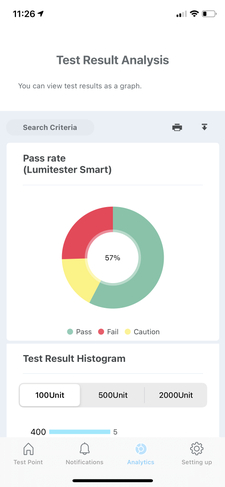 Exportable Data and Reports for Regulatory Compliance
 See how A3 technology finds what ATP technology can’t